

 Facebook
 X
X
 Pinterest
 Copy Link
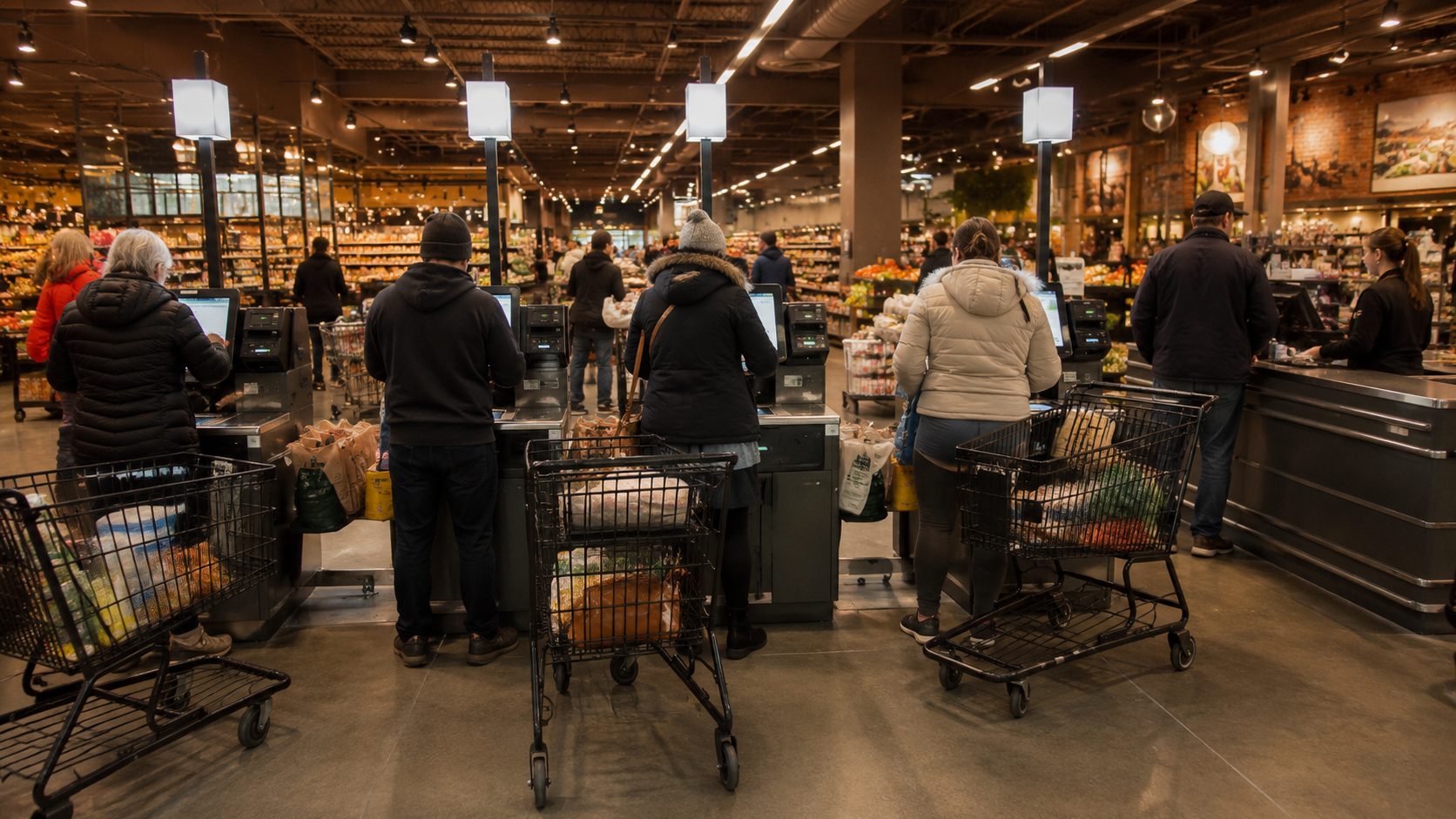
When Did We Start Working for the Grocery Store?
Or maybe the better question is… when did we start working everywhere?
How Self-Checkout Changed the Way We Shop
Anyone who knows me knows exactly how I feel about self-checkout.
I avoid it whenever I can.
Especially around 7:00 p.m., when everyone has just gotten off work, they’re trying to grab something for dinner, and somehow the store decides that’s the perfect time to have one cashier open and a sea of self-checkout machines.
Want to see my attitude go from zero to one hundred real quick?
That’s how you do it.
I have actually put my groceries back and walked out before because self-checkout was the only option.
Some people will probably think that’s ridiculous.
Maybe it is.
But if I’m already spending hundreds of dollars on groceries, the least I expect is for someone to ring them up.
And don’t even get me started on…
“Unexpected item in the bagging area.”
The machine has said those words to me so many times, I’m starting to take it personally.
Or scanning three items before the screen freezes and an employee has to come over anyway.
At that point, you might as well finish checking me out.
Call me old-fashioned.
I like people.
I like saying hello.
I like the little conversations that remind us there are still real people behind the counter.
I like knowing someone has a job to come to tomorrow.
And selfishly…
I like leaving the store feeling like the customer instead of the unpaid employee.
The funny thing is, though, the more I thought about it, the more I realized this article isn’t really about self-checkout.
It’s about something much bigger.
It’s about how quietly our expectations change.
A few days ago, I wrote about how it feels like everything in life is trying to rush us in Sunday Leisure: Why Is Everything Trying to Rush Us? That conversation wasn’t really about Sundays. It was about how we’ve become so focused on saving time that we rarely stop to ask whether we’re actually enjoying it. The more I thought about this, the more I realized this article is really the next chapter of that conversation.
If we’ve stopped slowing down…
Have we also stopped noticing how much of the work we’ve quietly taken on ourselves?
It Was Never Just About Groceries
Then I realized it wasn’t just the grocery store anymore.
I noticed it at Walmart.
Then Target.
Wawa.
CVS.
Walgreens.
Dollar Tree.
Dollar General.
Home Depot.
Lowe’s.
Even Little Caesars has you punch in a code, wait for a heated locker to unlock, open the door yourself, and retrieve your own pizza.
That’s when it hit me.
This wasn’t a grocery store trend anymore. It was becoming the way we shop.
One day I caught myself wondering…
When did we all become part-time employees everywhere we shop?
Before anyone comes for me, no, I’m not anti-technology.
I order online.
I use apps.
I pay bills from my phone.
I appreciate technology when it genuinely makes life easier.
This isn’t about resisting progress.
It’s about noticing it.
Because the biggest changes in society rarely happen overnight.
They happen one small convenience at a time.
One self-checkout lane.
One kiosk.
One QR code.
One mobile app.
One automated locker.
One “Skip the Line.”
Until one day we wake up doing things businesses used to do for us…
…and we hardly think twice about it.
That’s fascinating to me.
Behavioral psychologists have long studied our tendency to accept gradual change simply because it becomes normal over time. The more incremental the change, the less likely we are to stop and ask whether it’s actually making life better.
Behavioral psychologists have long studied how people adapt to change over time. The more gradual the change, the less likely we are to stop and ask whether it’s actually making life better. That pattern is echoed throughout behavioral economics research, which has found that consumers often rely on familiar routines and subtle cues when making everyday decisions, even when better alternatives may exist.
Maybe that’s exactly what happened here.
We were sold convenience.
But somewhere along the way, we started doing more of the work, paying more for the groceries, and somehow calling it convenience.
As the U.S. Bureau of Labor Statistics’ Consumer Price Index has documented, grocery prices have increased over time, making every trip to the store feel a little more consequential for many
Now, to be fair…
I understand why self-checkout exists. From the retailer’s perspective, it makes sense. The Food Industry Association (FMI) has highlighted ongoing investments in technology as grocery stores balance staffing challenges, operating costs, and changing customer expectations.
Retailers continue to deal with staffing shortages.
Operating costs have increased.
Technology can shorten lines in the right circumstances.
Many customers genuinely prefer it.
If you only have a few items, it can absolutely be faster.
Some people don’t want small talk after a long day.
Others appreciate the privacy.
Those are all fair points. In fact, Associated Press reporting has shown that some retailers are expanding self-checkout while others are scaling it back after weighing customer feedback, theft concerns, and operational challenges. There doesn’t seem to be a one-size-fits-all answer.
Convenience isn’t one-size-fits-all.
But convenience is only convenient when it actually feels convenient.
Standing in line behind twelve people waiting for four self-checkout stations doesn’t feel convenient.
Scanning thirty items while trying to keep bread from getting crushed by canned goods doesn’t feel convenient.
Stopping every few minutes because the machine wants an employee to approve something doesn’t feel convenient.
Watching one exhausted employee bounce from one flashing screen to the next certainly doesn’t look convenient for them either.
So it made me wonder about something else…
Should Customers Get Something in Return?
If I’m scanning my groceries…
Bagging them…
Looking up produce codes…
Fixing machine errors…
And waiting for assistance anyway…
At this point, can I put “Part-Time Cashier” on my résumé?
I feel like I’ve got enough experience.
I’m kidding…
Mostly.
But it does make me wonder…
The Real Question
If customers are doing part of the checkout process, should there be some kind of incentive?
Before anyone misunderstands me, let me be crystal clear.
I’m not talking about the “five-finger discount.”
Shoplifting isn’t funny.
It hurts businesses.
It contributes to higher prices.
It increases security costs.
It’s one of the reasons more everyday products end up locked behind plastic cases.
And in the end, honest customers pay for it one way or another.
That’s not the answer.
But I do think it’s fair to ask a different question.
If businesses save money when customers perform part of the checkout process…
Why isn’t there any incentive for the customer?
Gas stations have offered lower cash prices for years because it can reduce certain processing costs.
Businesses reward customers all the time when customers help reduce operating expenses.
So why is self-checkout different?
Maybe self-checkout users should earn extra loyalty points.
Maybe a small discount.
Maybe a digital coupon.
Maybe nothing at all.
I’m not pretending to know the economics behind every retailer.
I’m simply asking the question.
Because somewhere along the way, customers became part of the checkout process, and almost nobody stopped to ask whether that changed the relationship between businesses and the people they serve.
And that’s what I find most interesting.
The Story Has Always Been Us
The story has always been us.
That’s probably why I find myself asking questions most people don’t.
A while back I wondered Why Do Complete Strangers Love Looking at Other People’s Houses?
Another time I asked When Did We Stop Knowing Our Neighbors?
Neither article was really about houses or neighbors.
They were about people.
This one is too.
Maybe communities don’t just change because new buildings go up.
Maybe they change because the people living in them slowly change too.
That’s something I explored in How Do You Know When a City Has Truly Grown Up?
Looking back, I think this conversation belongs in that same family.
Whether you’re shopping at Food Lion in Hampton…
Kroger in York County…
Publix in Suffolk…
Harris Teeter in Virginia Beach…
Lidl in Newport News…
Or anywhere else across Hampton Roads…
You’ve probably experienced some version of this.
Maybe you love self-checkout.
Maybe you avoid it like I do.
Maybe you couldn’t care less either way.
That’s okay.
This article was never really about choosing a checkout lane.
It was about paying attention.
How many things have we accepted simply because they happened slowly enough that we stopped noticing?
How many conveniences actually make life more convenient?
How many simply shifted the work from one side of the counter to the other?
Progress isn’t automatically good.
Progress isn’t automatically bad.
Sometimes it’s both.
Sometimes it depends on who’s benefiting.
And maybe that’s the better conversation to have.
I still don’t like self-checkout.
I’ll probably still avoid it.
I’ll probably still sigh every time I hear…
“Unexpected item in the bagging area.”
But now, every time I stand there scanning my own groceries…
I’ll probably be thinking about something much bigger.
Not whether the machine works.
Not whether the line is moving.
But what other parts of modern life changed so gradually…
That I never stopped to ask whether they actually made life better…
Or whether I simply got used to them.
Maybe that’s why I’m so fascinated by these ordinary moments.
They often tell us more about ourselves than the headlines ever do.
Maybe the grocery store didn’t change as much as we did.
Final Thought
The next time you’re standing at a self-checkout, waiting for an employee to clear yet another error, ask yourself one simple question:
What else have we quietly accepted without ever stopping to decide whether it was actually an improvement?


