 Facebook
 X
X
 Pinterest
 Copy Link
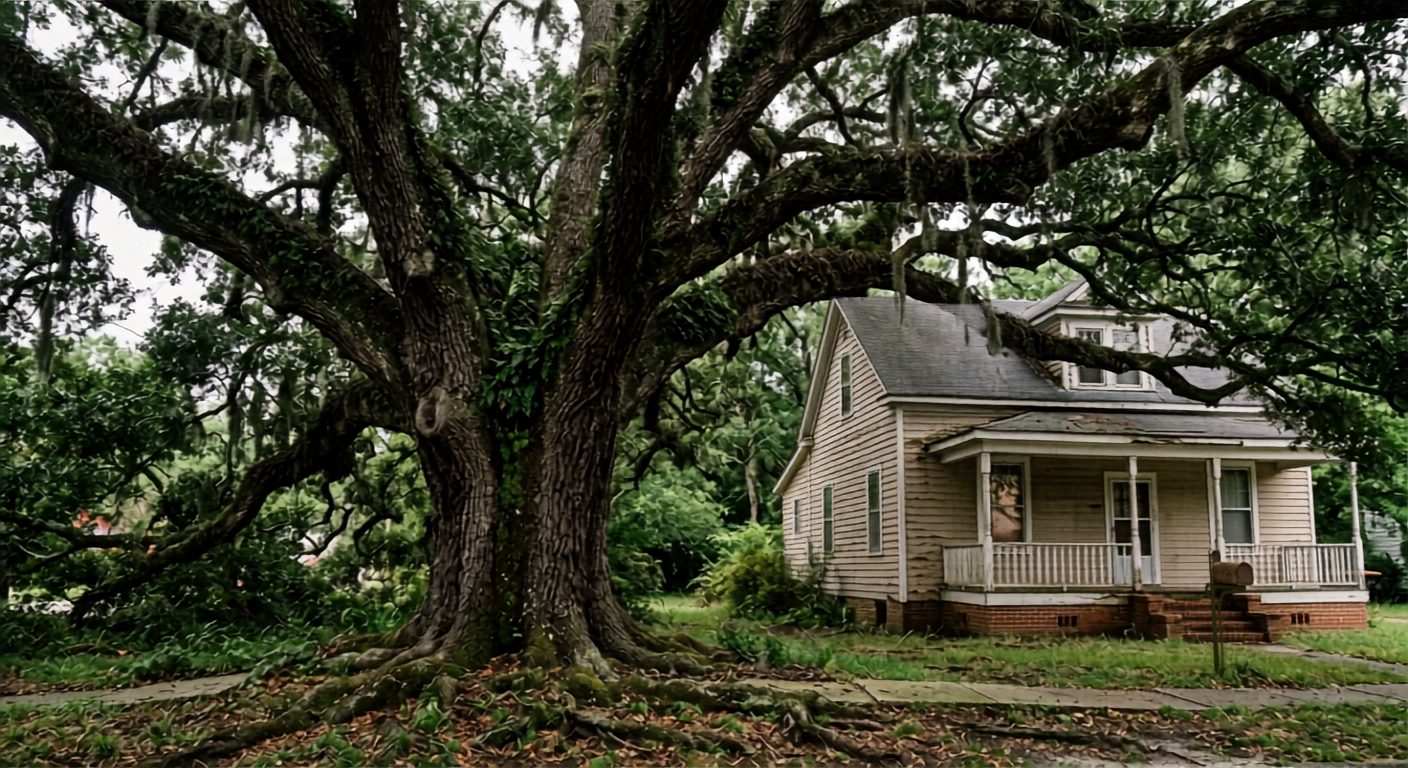
The Oldest Living Thing on Your Property
What if the oldest resident on your property isn’t your home, but the life that was there long before it?
Look around your property. The oldest living thing on your property probably isn’t your house.
It isn’t the fence.
It isn’t the mailbox.
It isn’t even you.
It’s probably the tree.
It was there before your driveway.
Before your closing documents.
Before your address existed.
Before anyone called this land “yours.”
And yet…
We can decide its fate in a single afternoon.
Who gave us that right?
Maybe no one did.
We simply assumed we had it.
The tree never asked to be useful.
Yet somehow it is.
It cools neighborhoods on the hottest summer days.
It cleans the air we breathe.
Its roots hold the soil together after heavy rains.
The U.S. Environmental Protection Agency explains that trees help improve air quality, reduce stormwater runoff, and cool urban environments.
Its leaves return nutrients back to the earth.
Its branches become homes for birds, squirrels, insects, and countless forms of life we rarely notice.
Children climb it.
Families gather beneath it.
Neighbors pause to admire it.
It quietly makes life around it possible.
The Arbor Day Foundation also notes that mature trees provide environmental, economic, and community benefits that extend well beyond curb appeal.
Generations grow up with it in the background, never realizing it has been watching over them all along.
And after decades, sometimes centuries, of giving…
We decide its life is over.
It blocks the view from a new deck.
It drops too many leaves.
Its roots might interfere with landscaping.
Because it no longer fits the aesthetic.
We Call It Improvement
The tree never argued with us.
It never asked anything from us.
It simply existed.
And somehow…
The oldest living thing on the property became the obstacle instead of one of its greatest assets.
We often describe this as “improving” the property.
The tree never gets a vote.
We clear the lot.
Open the view.
Clean up the landscape.
Listen to those words.
They imply that nature was the problem.
That somehow a mature oak became an inconvenience instead of the reason the land was beautiful in the first place.
Every place carries a story long before we become part of it. That’s an idea I explored in Every House Has a Story. Does Every City.
Ownership or Stewardship?
Buying land gives us legal rights.
No one disputes that.
If a tree is diseased, threatening a home, damaging a foundation, or creating a genuine safety hazard, removing it can be the responsible decision.
Property rights matter.
Protecting your family matters.
This isn’t an argument that every tree should remain standing forever.
But maybe that’s not the real question.
Maybe the real question is whether we’ve confused ownership with stewardship.
A deed says you own the property.
It doesn’t mean you created the ecosystem.
That tree may have stood there for 250 years.
Long before your home existed.
Long before property lines were drawn.
Long before your name ever appeared on a deed.
It survived hurricanes.
Lightning strikes.
Droughts.
Changing seasons.
Entire generations came and went beneath its branches.
A Tree Never Gets to Appeal
Imagine living for 250 years.
Watching children become grandparents.
Providing shade to people you’ll never know.
Filtering the air without asking for recognition.
Holding the soil together after every storm.
Giving life simply by being alive.
Only to lose your life because someone wanted a different landscaping plan.
The tree never gets to explain its value.
It never gets to defend itself.
It never gets to appeal our decision.
We are judge.
We are jury.
We are executioner.
And somehow…
We call it an improvement.
The Cost of a Better View
Here’s the uncomfortable contradiction.
We say we love nature.
Then we remove it because it blocks our view.
We want wildlife.
Then we eliminate the places where wildlife lives.
We complain that our neighborhoods are getting hotter.
Then we cut down the very shade that kept them cooler.
We replace a living ecosystem with decorative landscaping and call it progress.
Research from the U.S. Forest Service shows that urban forests support biodiversity, improve public health, reduce urban heat, and make communities more resilient.
We spend thousands of dollars planting young ornamental trees after removing mature ones that could never truly be replaced.
We call it landscaping.
Nature might call it something else.
Of course, there are times when removing a tree is the responsible choice.
Some are diseased.
Some become dangerous.
Some threaten homes and the people inside them.
Sometimes the right decision is also the hardest one.
This isn’t an argument against every chainsaw.
It’s an invitation to think more carefully before we start one.
Progress has given us extraordinary things.
Safer homes.
Stronger communities.
Modern infrastructure.
None of those are inherently wrong.
But progress is worth examining when it quietly teaches us that the oldest living thing on a piece of land is also the easiest thing to erase.
Perhaps the measure of a beautiful neighborhood isn’t how perfectly every yard is manicured.
Perhaps it’s whether we’ve learned to build around what was already beautiful.
One Final Question
Because once a 250-year-old tree is gone…
No amount of money can buy back 250 years.
A living thing that took a century, maybe two, to become what it was.
Gone before dinner.
Just because we can…
Does that mean we should?


